

|
A Natural Setting for Growth
Cambridge Research Park creates an outstanding business environment
|
The first-time visitor to Cambridge Research Park might
be forgiven for wondering whether he has entered a nature reserve with
high-tech office accommodation or a business park with an unusually benign
environmental policy. Certainly, the low density of the development is
the first thing to strike you. When finished, some 600,000 sq.ft. of business
space will be sparsely distributed throughout a vast 112 acre park, and
even the car parking areas are divided by avenue upon avenue of trees.
Initial impressions are not mistaken. Slough Estates, the owner and developer,
has taken its environmental responsibilities very seriously indeed - even
to the extent of appointing a consultant ecologist, Martin Newcombe, who
in turn has appointed a consultant ornithologist and a newt specialist
- all with the management’s enthusiastic approval.
At least one quarter of the total area of the park is given over to feature lakes and woodlands, both existing and new excavations and plantings. This is extraordinary enough in itself. What is even more remarkable - indeed unique - in a development of this kind, is the fact that the Park has its own wildlife reserve, a combination of a wildlife lake, a willow wood and a well preserved Roman canal - Car Dyke - which is also a scheduled monument.
Slough Estates have invested some £2.7m in the maintenance and enhancement of natural fauna and flora of the site, including an on-going ecological management plan. The objective, or as Martin Newcombe describes it, the inspiration and vision of the investment is to recreate, in miniature, the original fenland environment - replete with reed beds, open water and wet woodlands - as it existed some 800 years ago in the days of Hereward the Wake.
At least part of that vision has already been achieved. The regeneration of the environment - including the planting of poplar and willow trees - has not only preserved the natural habitats of Golden Oriel and Great Crested Newts, which have traditionally nested and bred here, but has also attracted rare new species like the Little Ringed Plover and several Red Book listed beetles and dragonfly. Indeed, for the benefit of ‘twitchers’ and nature lovers in general, hides are being erected from which the panorama of wildlife on the Park can be viewed.
|
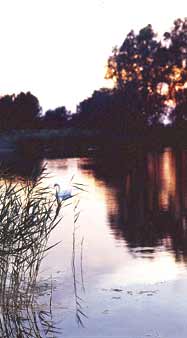
Even the main commercial area of the Park will be planted with new plane trees furnished with bird and bat boxes. And, needless to say, the boardwalks which span the central lakes and the terraces which overlook them, also make a very agreeable environment for Park employees.
The man behind the design concept for the Park is Slough Estates’ Chief Architect, Ian McKee, who describes the scheme as one of the most exciting of his career. Given his past record - he is responsible for some of the Group’s most prestigious developments - that is quite a boast.
“Concepts of a good working environment are currently under-going a sea change” says Ian. “Gone are the machine-like, hierarchical days of the 80’s - bland and sterile - arriving is the creative, individual and friendly workplace”.
Like nearly all of Slough Estates development activity, Cambridge Research Park recycles land on a brownfield (i.e. previously used) site, a policy that has won the company an outstanding reputation for its environmental awareness. In a survey conducted last year by Business in the Environment (part of Business in the Community), Slough Estates were ranked ninth amongst the FTSE mid-250 companies for environment performance - and first amongst property companies.
Since most brownfield sites occupy prime locations - and Cambridge Research Park is no exception - potential occupiers get the best of both worlds. It’s hard to believe, in such a tranquil setting, that you're just five miles from Cambridge city centre, and even closer to the A10/A14 intersection, connecting immediately to the west with the M11 (junction 14).
Slough Estates is a long time supporter of environmental charities such as Groundwork, the National Trust and Wildlife Trusts in the Thames Valley and Cambridgeshire. And within the southern boundary of Cambridge Research Park they have even set aside land for an on-site wild-life refuge. Rarely have science and nature complemented each other so well.